
A few years back we shipped a horizontally scalable authentication microservice for a US nonprofit scientific standards-setting organization. It runs on Spring Boot and the JVM, and today it serves all their users. Around the same time we built Bar.Stream from scratch, the hospitality automation platform we still run for its bar and restaurant customers, a live, revenue-generating product. Parts of it run on Robomotion.io, with deployed agents sourcing POS data, specifically the bits that talk to a lot of external services at once. Same team, same JVM, yet two very different architectures: one a lean compute-and-security service, the other offloading its integration-heavy work to agents rather than blocking threads on it. That wasn't an accident, and it wasn't religion. It was the workload, and matching the runtime to the workload is the whole reason the Spring Boot versus Node.js question has a real answer.
So when a client asks us the Spring Boot vs Node.js microservices question, "which one should we build this on?", the honest answer is that it depends on what the service actually does. "It depends" is a cop-out if you stop there. We won't. Here's how we decide, the tradeoffs that have burned us, and a default we'll stand behind.
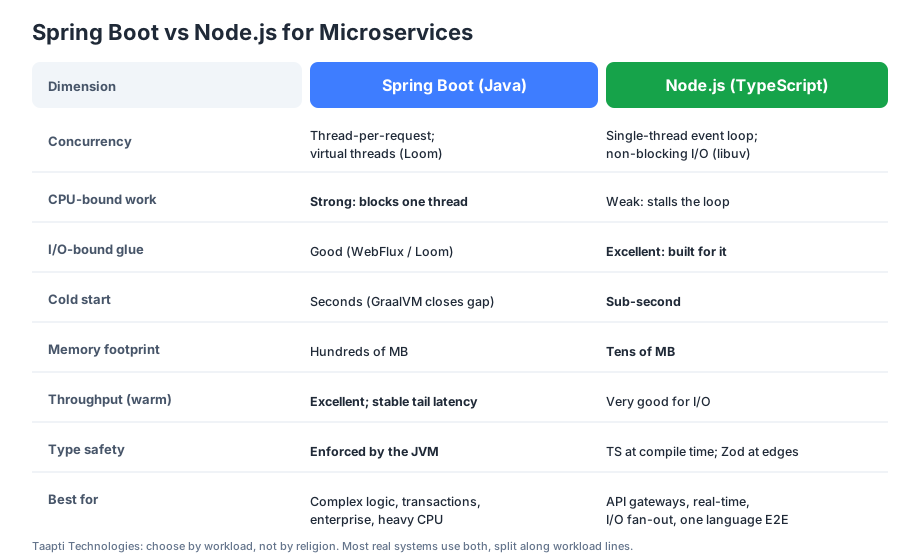
The concurrency model is the whole argument
Almost everything downstream comes from one difference. Node.js runs your JavaScript on a single thread with an event loop, and I/O is non-blocking, handled by libuv's thread pool underneath. Spring Boot, classically, hands each request a thread from a pool and lets that thread block.
Sounds like Node wins by default. It doesn't.
Node is excellent when a service spends its life waiting on other things: database calls, third-party APIs, message queues, S3. One thread can juggle thousands of in-flight requests because none of them are doing real CPU work. They're all parked, waiting on a socket. For an API gateway or a BFF (backend-for-frontend) that fans out to six microservices and stitches the responses back together, Node's model genuinely fits. Low overhead per connection, fast to write, async baked in.
Put CPU work on that single thread, though, and the whole thing stalls. We've hit this. A synchronous parsing step inside a Node request handler blocked the event loop, and latency for every other request on that instance fell apart with it. The fix wasn't clever code. It was moving the heavy work off the request path entirely: worker threads first, then a separate service. CPU-bound work in Node means worker_threads, child processes, or "just don't put it here." That's a real operational tax, and people underestimate it.
Spring Boot doesn't fail the same way. A blocked thread blocks one request, not all of them. For CPU-heavy or mixed workloads, think heavy validation, crypto, large in-memory transforms, an auth service doing token and signature work on every request, thread-per-request is boring and predictable. Boring is exactly what you want for an auth service running in production at national scale, the way that one does. And with Java 21's virtual threads (Project Loom), Spring Boot 3.2+ gets most of Node's cheap-concurrency-for-I/O benefit without rewriting everything in a reactive style. We've started turning it on for new JVM services. It's quietly excellent.
Spring WebFlux vs Node.js, and the Java virtual threads vs event loop question
If your service is mostly I/O and glue (reach out, wait, combine, return), Node.js is fast to build and runs lean. If it does meaningful computation per request, or you just want one mental model that survives a junior engineer adding a blocking call by accident, Spring Boot is the safer floor. This is really the Java vs Node.js for backend decision in miniature.
Reactive Spring (WebFlux plus Project Reactor) exists to give the JVM Node-style non-blocking I/O. We use it, eyes open. Debugging a Reactor chain is harder than debugging an async/await stack. The stack traces are famously ugly, and one misplaced block() call quietly defeats the entire point. Here's the shift worth understanding: the Java virtual threads vs event loop comparison has changed the math. Virtual threads give you Node-like I/O scalability with plain, readable blocking-style code, so we reach for WebFlux less than we used to.
Type safety and the maturity gap
We default to TypeScript on every Node service. Plain JavaScript on a backend that has to live for years, in 2026? No. The day a refactor renames a field and nothing tells you until production is the day you regret it.
Here's the uncomfortable part. TypeScript is a compile-time hint that erases at runtime. It does not validate the JSON that just arrived from a flaky upstream. You still need Zod or io-ts at the boundaries, and plenty of teams skip that step and get burned. Java's types are enforced by the JVM, full stop, and Spring's ecosystem assumes strong typing everywhere: Bean Validation, typed repositories, all of it. For a domain with genuinely complex business rules and money on the line, that rigidity is a feature, not a tax.
The maturity gap shows up most in the unglamorous parts. Spring's story for transactions, connection pooling (HikariCP is just there, and it's excellent), security, and observability runs decades deep. Spring Security is a beast to learn and a gift once you have it. On the Node side you're assembling Express or Fastify plus a dozen libraries of varying quality. Both can get you there. One asks more decisions of you. For a lot of enterprise teams, that built-in depth is exactly why Spring Boot ends up being the best backend framework for microservices they have to maintain for a decade.
Spring Boot vs Node.js performance: throughput, latency, and memory
Here Node has a real, measurable edge that matters for some architectures and not for others.
- Cold start is where Node has the clearest lead. A Node service is up in well under a second, while a traditional Spring Boot app on the JVM can take several seconds to start and warm up while the JIT does its thing. If you run lots of small services that scale to zero, or genuine serverless functions, that startup tax stings. GraalVM native images (via Spring Native) close most of the gap, but they add build complexity and break some reflection-heavy libraries.
- Memory footprint follows the same pattern. A baseline Node service idles in the tens of megabytes, and a Spring Boot service usually wants a few hundred. Pack many replicas onto nodes and that shows up on the cloud bill.
- Throughput under load flips it. Once warm, the JVM is a monster. For sustained, high-throughput, CPU-touching work, a warmed-up Spring Boot service usually wins on raw throughput, and more importantly on tail-latency (p99) consistency, thanks to mature garbage collectors like G1 and ZGC.
Node is cheaper at rest and faster to start. The JVM is stronger under sustained pressure. On any Spring Boot vs Node.js performance benchmark, pick the one whose curve matches your traffic rather than the one with the bigger headline number.
When to use Node.js vs Java: the factor nobody benchmarks
We've watched the cleanest technical decision fall apart because the team couldn't maintain it. A reactive WebFlux codebase handed to engineers who only know servlet-style Spring is a liability, not an asset.
And sometimes the right answer is neither Spring Boot nor Node.js. We built an invoice-automation platform, whose automated vendor comparison and reconciliation replaced work the client used to do by hand, as a Python platform, because the parsing and ML-heavy core belongs in Python's ecosystem, not on the JVM or an event loop. That's the whole point of choosing by workload: the runtime that ships and stays maintainable beats the one that wins a microbenchmark. Every time.
Questions
Frequently asked questions
Is Spring Boot faster than Node.js?
It depends on the workload. Node.js starts faster and idles leaner, a baseline service comes up in well under a second and sits in the tens of megabytes, while a traditional Spring Boot app can take several seconds to warm up and usually wants a few hundred megabytes. Once the JVM is warm, though, Spring Boot generally wins on sustained high-throughput CPU-touching work and on p99 tail-latency consistency, thanks to mature garbage collectors like G1 and ZGC. Pick the runtime whose performance curve matches your traffic rather than the one with the bigger headline number.
When should you use Node.js vs Java?
Use Node.js when the service is mostly I/O and glue (call out, wait, combine, return), real-time, or you want one language across front and back. Reach for Java and Spring Boot when the service does meaningful computation per request, has hard transactional and durability needs, or has to stay maintainable across a multi-year enterprise lifespan. Node is fast to build and cheap to run; the JVM gives you strict types and a deep security and data toolkit that Spring assumes everywhere.
Is Node.js good for microservices?
Yes, for I/O-bound microservices Node.js is an excellent fit. A single thread with a non-blocking event loop can juggle thousands of in-flight requests when they are all parked waiting on databases, third-party APIs, or queues, which suits an API gateway or a backend-for-frontend that fans out and stitches responses back together. The caveat is CPU work. Heavy computation on that single thread blocks the event loop and stalls every other request, so it has to move to worker threads or a separate service.
Do Java virtual threads replace Node's event loop?
No, they are different mechanisms, but virtual threads give the JVM Node-like I/O scalability without adopting an event loop. Java 21's virtual threads (Project Loom), available in Spring Boot 3.2 and later, let you write plain, readable blocking-style code that still scales for I/O-heavy workloads. That has changed the math enough that we reach for reactive WebFlux less than we used to, since virtual threads deliver most of the concurrency benefit without the ugly stack traces and the misplaced block() calls that quietly defeat the point.
Is Spring Boot or Node.js better for microservices?
Neither wins outright; the better choice depends on what each service actually does. For I/O-bound glue, real-time work, or a shared front-and-back language, Node.js with TypeScript and Fastify is a strong default, with Zod validating at the edges. For serious business logic, heavy CPU work, or a multi-year enterprise system that needs strict types and deep security tooling, Spring Boot on Java 21 with virtual threads fits better. Most real systems end up as both, split along workload lines and talking over well-defined contracts.
Our default
Starting fresh, and the service is I/O-bound glue, real-time, or you want one language across front and back? Node.js with TypeScript and Fastify is our default for Node.js microservices, Zod at the edges. Quick to build, cheap to run.
Anything with serious business logic, hard durability and transactional needs, heavy CPU work, or a multi-year enterprise lifespan where you'll want strict types and a deep security and data toolkit? Spring Boot on Java 21 with virtual threads is what we reach for. It's the call we'd make for another national-scale auth service tomorrow, and Spring Boot development is what most of our weeks actually look like.
Most real systems we build aren't one or the other. They're both, split along workload lines, talking over well-defined contracts. If you want a second opinion grounded in what your service actually has to do, that's the kind of call our backend development team makes with clients every week. Sometimes the answer is that neither of us should be reaching for a new microservice at all.